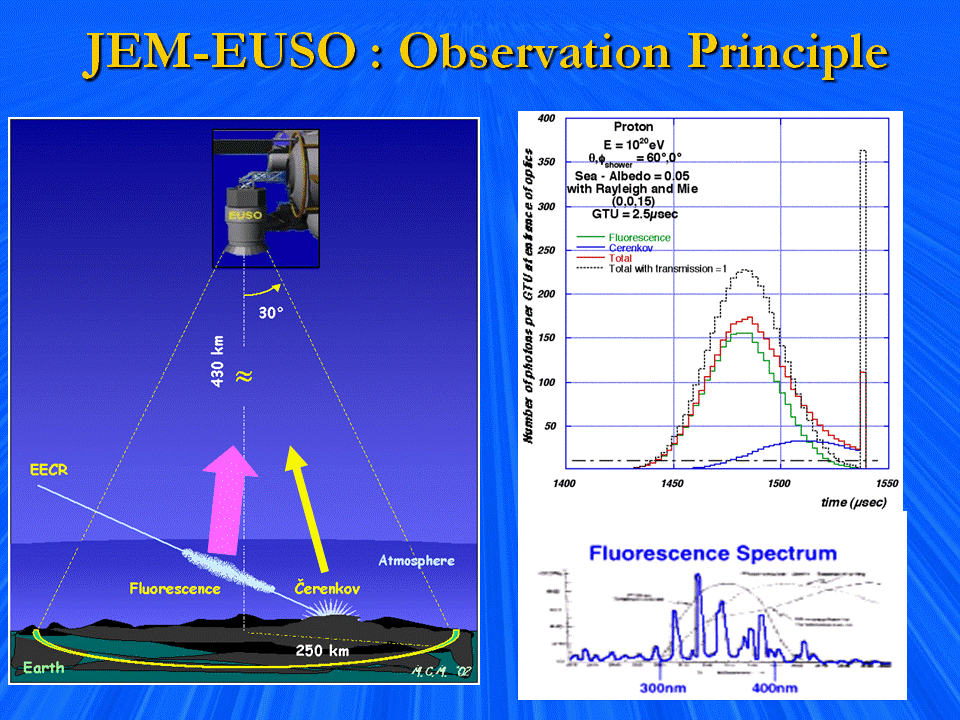
In the JEM-EUSO mission, the EECR observation
is based on the measurement of the fluorescence and Cherenkov photons produced
in the extensive air shower (EAS) phenomenon. An EECR, colliding with
atmospheric nuclei, produces secondary particles that in turn collide with the
air atoms giving rise to a propagating cascade of particles. The number of the
secondary particles in an EAS is related to the energy of the primary EECR; for
example, as many as an order of 1011 particles at the maximum of the shower
development from a 1020 eV EECR. The most dominant particles in EAS
are electrons moving through the atmosphere, which excite metastable energy
levels in atmospheric atoms and molecules, in particular, nitrogen. With a short
relaxation time, electrons from those energy levels return to ground state
emitting characteristic fluorescence
light. In air the peaks of
such fluorescence light lie in the ultraviolet
(UV) band with wavelengths
between 330 and 400 nm. The emitted light is
isotropic
and its intensity is proportional
to the energy deposited in the atmosphere. An EECR-induced EAS then forms a
significant streak of fluorescence light along its passage in the atmosphere, depending
on the energy and zenith angle of the primary EECR.
Numerous secondary particles have velocities higher than that of light and
therefore they emit Cherenkov
photons. These Cherenkov
photons are highly beamed within a
cone of <1.3° radius along the trajectory
and may be scattered by the molecular and aerosol content in the atmosphere. A
part of those photons will be isotropically diffused when reaching land, sea or
clouds.